

Inside GOA’s bold plot to repeal one of America’s strongest firearms laws
Written by
The Guardian Published: 05 September 2025
How Gun Owners of America changed the fight to gut the NFA from a “fringe view” to mainstream on Capitol Hill
Before Donald Trump had even won last year’s presidential election, Gun Owners of America, one of the country’s most aggressive second amendment champions, saw an opportunity to use the coming budget bill to overturn one of the country’s core gun laws. Their target: the National Firearms Act.
Passed in 1934 in response to gangster-era crime, the NFA imposed registration and a $200 tax on machine guns, silencers, and short-barreled rifles and shotguns. The tax roughly equaled nearly $5,000 back then, acting as a de facto ban for most would-be buyers.
Few American gun laws stand on firmer ground than the NFA. The law surmounted its most serious legal challenge eight decades ago, when the supreme court ruled against a pair of suspected bank robbers who argued that taxing a sawn-off shotgun violated their right to bear arms.
Lawmakers have not seriously considered repealing it any time in recent memory. A bill that would eliminate NFA restrictions only for suppressors, increasingly popular devices that muffle gunshots and make firearms easier to control, has languished in Congress for a decade. Until very recently, trying to overturn the NFA would have seemed like a Hail Mary at best.
But as the frenzied debate over Trump’s budget bill played out this summer, the push to gut the NFA transformed from a fringe view into a broadly supported position, embraced across the spectrum of gun groups and increasingly backed by establishment Republicans. Now, they are taking that fight to the courts, while scanning the horizon for their next major battle.
“The change is fantastic,” said Luis Valdes, a Gun Owners of America spokesperson. “It shows you that it’s a grassroots effort. Americans all over the country are tired of their rights being violated.”
The ‘no compromise’ lobby
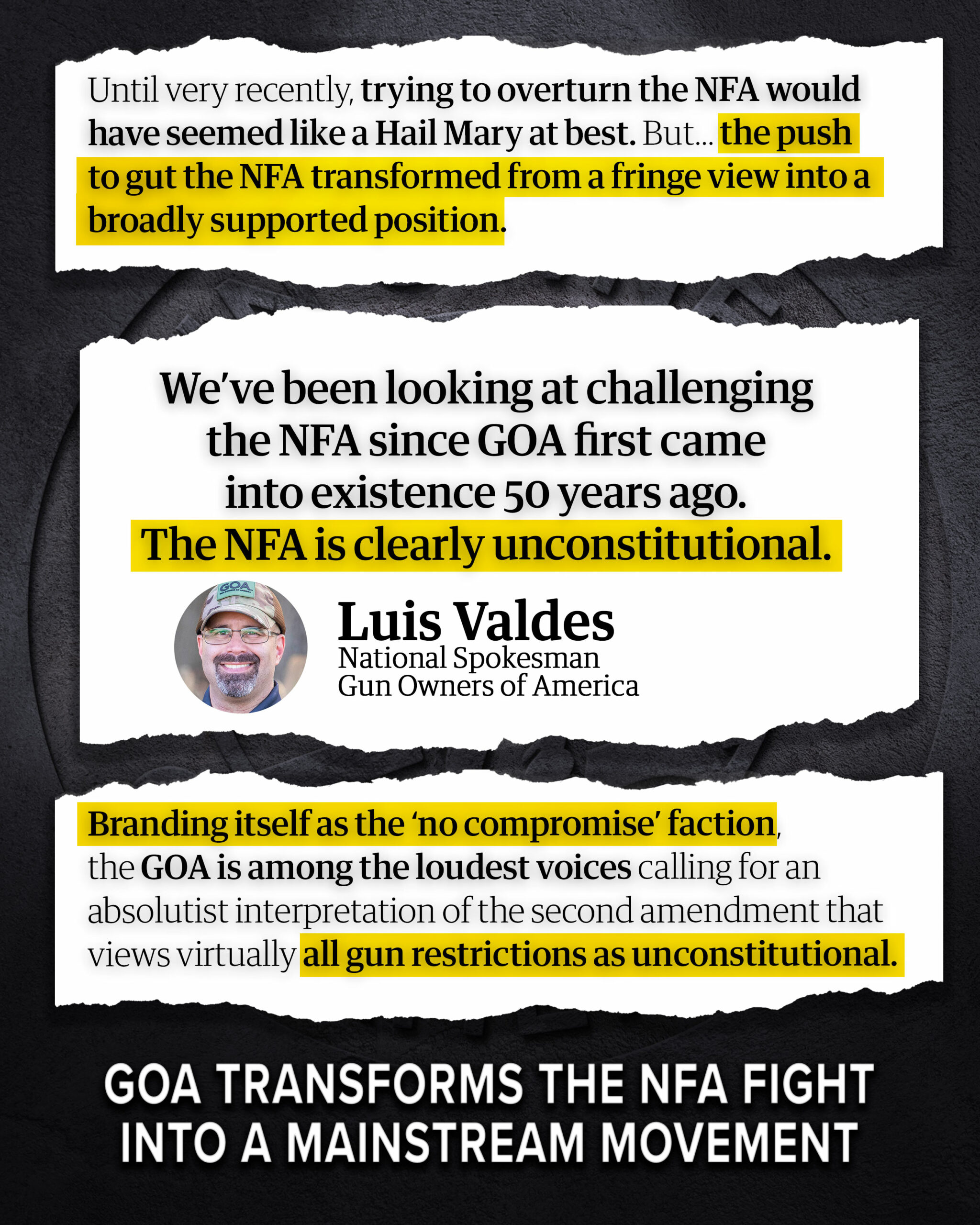
Branding itself as the “no compromise” faction, the GOA is among the loudest voices calling for an absolutist interpretation of the second amendment that views virtually all gun restrictions as unconstitutional. It’s the pressure group for those who view the National Rifle Association as too soft on guns.
Though founded five decades ago, the GOA has seen its political star rise in tandem with Trump’s, with its revenue nearly quadrupling to $9.6m over the last decade, according to tax filings.
Its worldview has also gained more traction. Major supreme court decisions dating back to 2008 have made it harder for governments to restrict gun rights in the name of public safety. An absolutist interpretation of the right to bear arms has resonated with the ascendant right wing of the Republican party, personified by Trump. And a significant share of the membership of the NRA, still the best-funded gun rights group by far, has flogged the organization’s leadership whenever it smells compromise, according to political scientist Robert Spitzer, who has authored six books on gun policy.
“The NRA has to watch its flank because these extremist groups like the Gun Owners of America have been relentlessly attacking the NRA as not being tough enough,” Spitzer said.
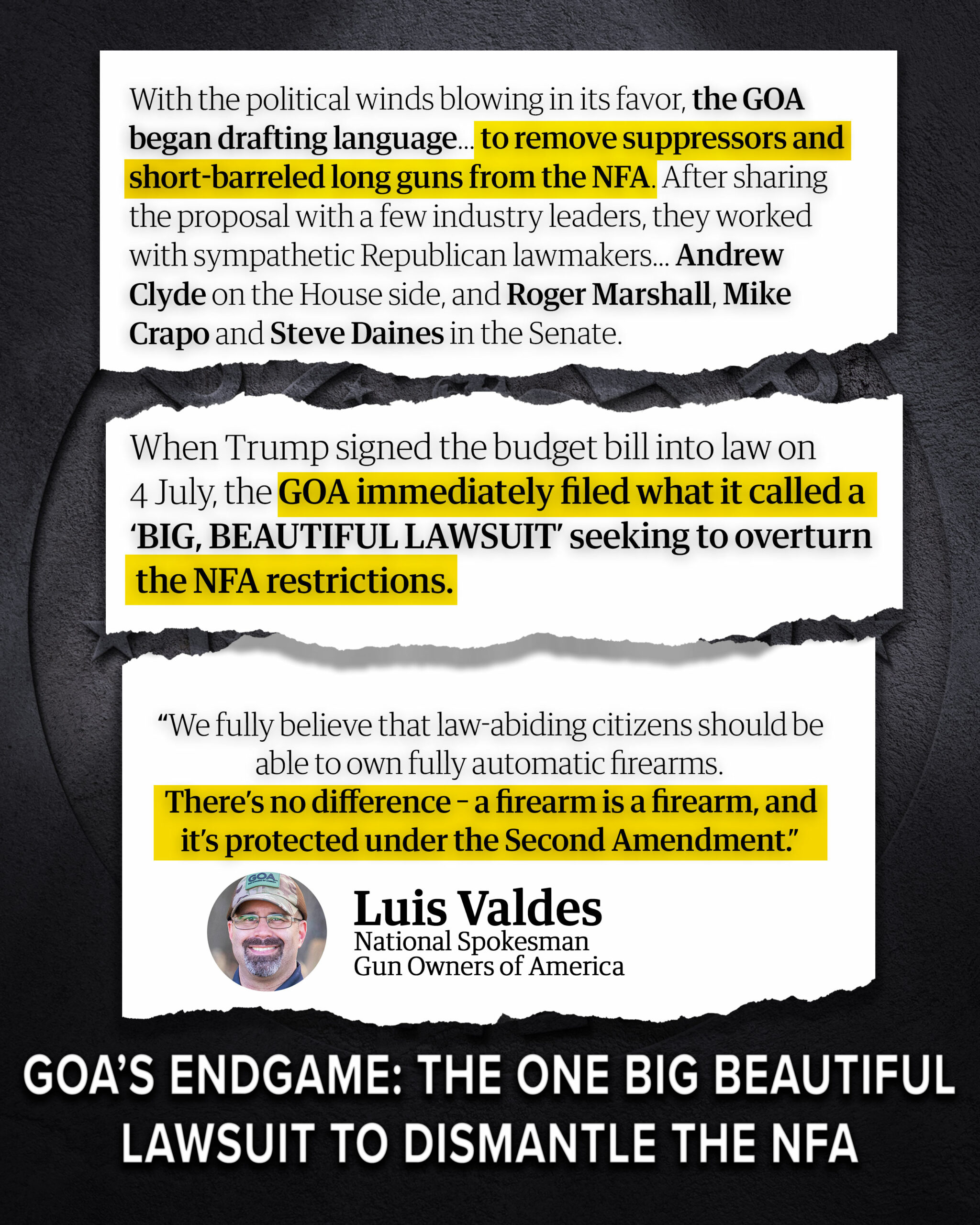
With the political winds blowing in its favor, the GOA began drafting language some time last year to remove suppressors and short-barreled long guns from the NFA. After sharing the proposal with a few industry leaders, they worked with sympathetic Republican lawmakers to wedge it into the budget reconciliation bill – Andrew Clyde on the House side, and Roger Marshall, Mike Crapo and Steve Daines in the Senate.
“We had the language and we had key members of Congress to introduce it,” Valdes, the GOA spokesman, said. “We’ve been looking at challenging the NFA since GOA first came into existence 50 years ago. The NFA is clearly unconstitutional.”
The move came at a hospitable time, with Trump urging Congress to use the budget reconciliation process to pass his “big, beautiful” bill, spurring a flurry of hasty lawmaking.
Still, the NFA proposal touched off weeks of high-stakes wrangling. The version passed by the House only removed the tax on suppressors – an easy sell to moderate Republicans, but which the GOA viewed as far too watered-down. The Senate version included a full repeal of silencers and short-barreled long guns from the NFA, only for the Senate parliamentarian, Elizabeth MacDonough, to find that the proposal violated the “Byrd rule” that bars extraneous measures from consideration during budget reconciliation. The GOA responded with a national alert calling to “fire the anti-gun parliamentarian now!”
The final version of the sweeping budget bill left intact the NFA’s registration requirements, which include some extra paperwork and fingerprint submission, but dropped the tax on suppressors, short-barreled rifles and short-barreled shotguns to $0. The changes left machine gun restrictions untouched.
It was a remarkably swift reversal of key provisions of one of America’s bedrock gun laws. But instead of declaring victory, when Trump signed the budget bill into law on 4 July, the GOA immediately filed what it called a “big, beautiful lawsuit” seeking to overturn the NFA restrictions on suppressors and short-barreled long guns entirely.
Within a month, 15 Republican-led states had joined as plaintiffs….
‘A firearm is a firearm’
Markets for suppressors and short-barreled long guns will almost certainly get a boost from the elimination of the $200 tax. A legal victory knocking down NFA restrictions entirely would make those items as easy to buy as a regular firearm, probably propelling the market still further.
That prospect is already raising concerns among gun control advocates, who view silencers and short-barreled long guns as a safety risk. Overturning the NFA altogether, they worry, might result in a loosening of restrictions on machine guns too – a nightmare scenario for gun reformers.
It’s unclear whether the coming litigation will affect restrictions on machine guns, a key component of the NFA. Congress left the $200 tax in place for machine gun sales. And the only fully automatic weapons that most civilians can legally possess are those produced before 1986.
The modern machine gun ban is enforced by a separate federal law, called the Firearm Owners’ Protection Act of 1986. Neither of the two major lawsuits challenge the NFA’s restrictions on machine guns.
But Valdes, the Gun Owners of America spokesman, said his group was already working to legalize machine guns in a separate lawsuit.
“We fully believe that law-abiding citizens should be able to own fully automatic firearms,” Valdes said. “There’s no difference – a firearm is a firearm, and it’s protected under the second amendment.”
Originally published by Roque Planas for the Guardian. Read the full story ›