

Comment Now To Stop the ATF’s Illegal Registry!
Written by
Erich Pratt Published: 11 May 2026
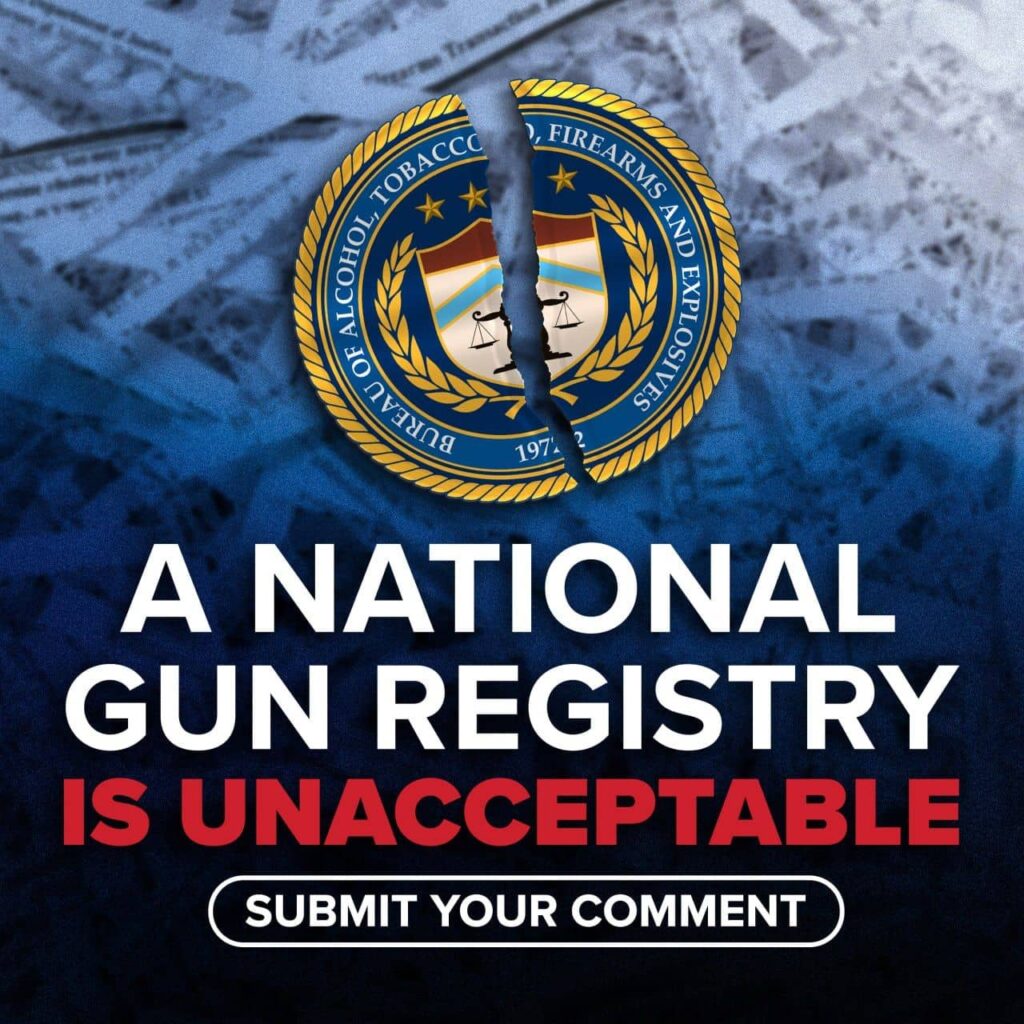 As part of ATF’s recent package of 34 new rules, they’ve proposed a change to their “out-of-business” records retention.
This record retention amounts to an unconstitutional, illegal registry of guns and gun owners.
The registry, compiled by ATF using Form 4473 — which is the dealer sales form completed by gun owners during firearms transactions — must be destroyed.
Now, thanks to a proposed rule change, gun owners have the ability to make their voices heard.
GOA is providing a model comment, so you can fight back against the ATF.
Preview comment
I join Gun Owners of America in strongly opposing ATF’s proposed rule, Firearm Records Retention Periods (RIN 1140–AA95), to the extent that it would continue requiring decades-long retention of firearm transaction records, and allow ATF to maintain out-of-business (“OOB”) dealer records for additional decades. While the proposal appears intended to partially roll back the Biden Administration’s “forever retention” policy adopted in 2022, merely returning to a 20- or 30-year standard is insufficient to protect gun owners’ privacy and constitutional rights.
The Firearms Owners’ Protection Act of 1986 (“FOPA”) prohibits post-1986 regulations that expand the transfer to or maintenance of firearm transaction records in government-controlled facilities. Any retention period exceeding the framework of 20 years that pre-existed FOPA would violate both the text and spirit of 18 U.S.C. § 926(a). Moreover, the Second Amendment does not tolerate the creation or preservation of a de facto federal registry of law-abiding gun owners much less one that exists for decades on end.
ATF’s own historical findings demonstrate that the law-enforcement utility of decades-old records is minimal. In its 1985 rulemaking, ATF acknowledged that trace usefulness sharply declines over time, especially after 10–15 years. Yet under the current framework, records may effectively be retained for generations—first by dealers, and then by ATF after a dealer goes out of business. Such a system transforms temporary business records into functionally permanent federal surveillance files of Americans’ firearm ownership.
ATF’s “new era of reform” should not merely be about returning to the pre-Biden status quo. Indeed, if ATF were to select 30 years as the retention, then this rulemaking would not even accomplish that. This would represent an utter failure in the eyes of gun owners by this Administration. ATF needs to make affirmative progress in the right direction—protecting gun owners by reducing record retention periods as much as possible.
Accordingly, I agree with GOA that ATF should adopt the shortest possible retention period permitted by law, ideally zero years. At a minimum, any retention period imposed on FFLs must also apply to ATF’s OOB records, with mandatory destruction upon expiration of that same period. ATF should use this rulemaking to dismantle—not preserve—the infrastructure of a national gun owner registry.
ATF’S NEW RULE: WORSE THAN OBAMA-ERA RETENTION
ATF’s new proposed rule change, “Firearms Records Retention Periods” continues to require decades-long retention of firearm transaction records.
Worse still, it also allows ATF to maintain their “out-of-business” dealer records for additional decades.
While the rule is a step in the right direction, (Biden required FFLs to keep records forever) it reverts to an Obama-era status-quo — that records should be kept by gun dealers for 20 to 30 years after the firearms transaction.
And of course, ATF is suggesting that they should be able to keep those records in their illegal registry for another 30 years after they receive them.
That’s 60 years of your information being held by the federal government.
ATF should adopt the shortest possible retention period permitted by law. Ideally, ZERO years.
That’s why we need GOA members to submit their comments to the federal register ASAP.
Our vocal grassroots members can hold ATF accountable.
GOA members have been crucial to change and have worked to stop bad policy in the past.
Here’s how it works:
Step 1: Copy our model comment, which is provided here.
Step 2: Then, with our model comment copied, paste it into the federal register’s comment section at the link below and submit your comment to the ATF.
Let them know that gun owners want real change, not a return to the status-quo.
ATF CANNOT RETURN TO THE STATUS-QUO. REAL CHANGE IS NEEDED.
ATF’s own historical findings demonstrate that the law-enforcement utility of decades-old records is minimal.
In its 1985 rulemaking, ATF acknowledged that trace usefulness sharply declines over time, especially after 10–15 years.
And the ATF itself admitted to Texas Rep. Michael Cloud that the agency “has no ability to determine” or link any crime gun traces to successful prosecutions.
Yet under the current framework, records may effectively be retained for generations—first by dealers, and then by ATF after a dealer goes out of business.
A return to the status-quo is not good enough for gun owners.
ATF should use this rulemaking to dismantle—not preserve—the infrastructure of a national gun owner registry.