
WV: Setting the Record Straight on SB 1071
Written by
by Gun Owners of America Published: 13 March 2026
Setting the Record Straight on SB 1071 in West Virginia
In recent days, West Virginia Senate President Randy Smith released a public statement regarding SB 1071, the Public Defense and Provisioning Act. His comments have created confusion about the bill’s drafting, legality, and level of expert review.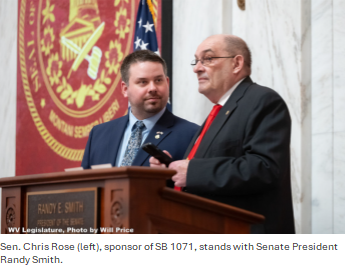
It is essential that West Virginians have the full and accurate factual record. Many of the claims made about SB 1071 do not reflect the truth, and the following information provides a clear, fact-driven response based on verifiable legal authorities and documented expert analysis.
A Bill with Momentum — and an Unexpected Intervention
The fight for modern firearms equality began in early February. West Virginia made national history when it became the first state in America to introduce legislation authorizing the lawful sale of post-1986 machine guns under the federal carve-out in 18 U.S.C.922(o)(2)(A).
SB 1071 immediately ignited excitement among legislators, industry leaders, and grassroots supporters. Other states quickly took notice—several have already copied West Virginia’s language, and more are preparing to introduce their own versions.
A flash poll conducted by Gun Owners of America showed overwhelming enthusiasm among West Virginians, with 94 percent saying their out-of-state family and friends would be more likely to move to West Virginia if this bill became law. The momentum was real, and the nation was watching.
SB 1071 was introduced by Senator Chris Rose, a member of the Senate Judiciary Committee, and the committee advanced the bill with overwhelming support. But immediately after that vote, the bill seemed to vanish.
Chairman Tom Willis, who had reported the bill out of Judiciary, was himself confused about why it had not moved to the Finance Committee as expected. This unusual stallprompted West Virginians across the state to begin calling their Senators, demanding answers about what had happened to a bill that had just passed committee with overwhelming support.
In response to the growing public concern, Senate President Randy Smith publicly stated that he personally made the decision to halt SB 1071, clarifying that the choice did not come from Chairman Willis or the Judiciary Committee. This admission dramatically shifted the understanding of events. What many initially believed to be procedural delay within Judiciary now appeared to be a direct intervention from Senate leadership.
Additionally, several advocates and legal experts have raised serious concerns that President Smith may have been relying on information provided by an outside individual who strongly opposed SB 1071 and may have misrepresented key legal facts about the bill.
According to these observers, this misinformation appears to have played a significant role in shaping the Senate President’s decision—ultimately stopping a bill that had strong public support, clear legislative interest, and validation from some of the most respected constitutional attorneys in the country.
This context is essential for understanding how SB 1071 was derailed and why an accurate factual record matters as West Virginians evaluate what happened and determine the path forward.
SB 1071 Was Carefully Drafted and Reviewed by Leading Constitutional Attorneys
Senate President Smith’s assertion that SB 1071 was “poorly drafted” or created without proper legal review is contradicted by the actual record. SB 1071 was reviewed, refined, and endorsed by some of the most accomplished constitutional litigators in the United States.
In addition to Gun Owners of America’s legal team, a number of well-respected Second Amendment attorneys around the country reviewed the theory behind SB 1071 in detail, and agreed that the legal theory—while untested—is sound.
These attorneys have argued and won cases before the U.S. Supreme Court, litigated major Second Amendment cases in the Second, Fifth, Sixth, Eighth, Ninth, and D.C. Circuits, and served as counsel in significant federal firearms law challenges involving the National Firearms Act and 18 U.S.C. 922(o).
These experts examined the statutory structure, the federal carveouts, and the administrative process contemplated in the bill and concluded that SB 1071 is fully consistent with federal law when implemented through the ATF Form 5 process. This is nota fringe interpretation; it is the position of attorneys who operate at the highest levels of federal constitutional litigation.
For example, Mark Smith is a constitutional attorney and member of the bar of the U.S. Supreme Court. His Four Boxes Diner podcast has been twice voted as the “Top Voice of the Second Amendment,” and his legal scholarship on the Second Amendment has been cited in litigation and legal briefs, including the Bruen and Rahimi cases.
Mark Smith spent an entire episode of his podcast analyzing SB 1071 in very favorable terms and said, “This West Virginia proposal is very legitimate [and] could have a very real impact on the Second Amendment community.”
The claim that SB 1071 would face insurmountable legal challenges is also contradicted by existing federal case law. In a recent filing in a Maryland federal district court, the Bondi Department of Justice interpreted 18 U.S.C. 922(o)(2)(A) in the same way that SB 1071 does. A federal judge on the U.S. Court of Appeals for the Ninth Circuit, Judge Lawrence VanDyke, recently interpreted the statute in the same way. That interpretation recognizes a clear statutory carveout allowing the United States, along with state and local governments, to acquire, possess, and transfer machine guns through the National Firearms Act’s established procedures.
Under this carveout, the federal government and the states may lawfully conduct such transfers, provided they comply with the ATF Form 5 approval process. SB 1071 was drafted precisely to operate within this framework, requiring state acquisition, state possession, state-initiated transfer, and mandatory federal approval before any civilian receives a firearm. This is the exact process federal courts have already acknowledged as lawful.
Questions About a Lobbyist’s Claims
It is also important to address the claim that SB 1071 could not pass the House of Delegates. In the days following its introduction, House members publicly expressedinterest in advancing the bill, multiple Delegates requested that it be placed on committeeagendas, and the House Judiciary Committee received extensive public support andindustry engagement. The bill generated unprecedented national attention and significanteconomic interest. The assertion that the House would not seriously consider the bill is not supported by the documented response from Delegates or the public.
The suggestion that SB 1071 lacked support from established gun rights organizations is incomplete. While the Senate President referenced the NRA and WVCDL, those organizations have been reported to be either in favor of the bill or neutral.
Even more concerning, Second Amendment journalist John Crump has reported that a lobbyist, who claimed to represent the NRA during this legislative session, was not acting
on the organization’s behalf. In fact, the NRA leadership reports that this individual has not represented the group for at least two years.
This means that Senator Randy Smith may have been intentionally misled by a lobbyist who was misrepresenting himself to Senators—not only about his role with the NRA, but about that organization’s position on the bill.
Moreover, Crump reports this “pro gun” lobbyist stated at gun show—in front of several witnesses—that he would kill this machine gun bill in West Virginia and in Kentucky.
Jared Yanis, who is the host of Guns & Gadgets, has invited this lobbyist to come on his program and explain himself, but as of this writing, that lobbyist has yet to accept the offer.
The Full Record Shows SB 1071 was Legally Sound and Broadly Supported
Senator Smith also omitted the fact that Gun Owners of America, one of the largest and most active national Second Amendment organizations, strongly supported SB 1071.Numerous West Virginia manufacturers, FFLs, and industry leaders endorsed the bill, and national firearms law scholars and litigators provided written and verbal support. SB 1071 generated more public engagement than any other firearms related measure this session. The claim that the bill lacked credible support does not reflect the record.
Concern about online behavior by some individuals does not change the legal merits of the bill. While no one condones harassment or threats, these incidents are not attributable to the bill’s authors, supporters, or Gun Owners of America, nor do they bear on the bill’s constitutionality or legislative merit.
Senator Smith implied that GOA encouraged supporters to protest at legislators’ homes. But that allegation is categorically false. Anyone who reviews our website and member alerts will find no instance where GOA has ever promoted such conduct.
In the end, these fallacious claims were a mere distraction—an intent to justify the killing of the bill. And this is why for seasoned veterans of the political process, legislation should be evaluated on its legal foundation, economic impact, and public benefit, not on isolated online comments.
Finally, the timing of the bill’s introduction does not diminish its legality or viability. SB1071 was introduced in accordance with the rules and deadlines of the West VirginiaSenate. Many significant bills are introduced later in session, and the Legislature routinely processes complex legislation on compressed timelines. The timing does not change the bill’s legal validity, economic potential, or national significance, nor does it alter the fact that the bill rests on sound legal theory which has been endorsed by the Department of Justice and federal judges.
To summarize, the factual record shows that SB 1071 was:
- Reviewed and endorsed by nationally recognized constitutional attorneys
- Supported by federal case law and DOJ litigation positions
- Fully compliant with 18 U.S.C. 922(o)(2)(A) and the ATF Form 5 process
- Backed by substantial public, industrial, and legislative interest
- Legally defensible and economically transformative for West Virginia
- Met West Virginia Senate Deadlines
Any evaluation of SB 1071 should reflect these facts, the existing federal and state carveouts, and the well-supported legal scholarship confirming that states may lawfully acquire and transfer machine guns under federal law.
Make sure to stay informed on the latest efforts to pass the machine gun bill into law, by following GOA on Facebook at: Gun Owners of America-West Virginia.